
BitBOINC
Thread 'POTAMOS'
Message boards : Puzzles and science : POTAMOS
Message board moderation
| Author | Message |
|---|---|
|
New member Send message Joined: 27 Sep 26 Posts: 41 Credit: 464,765 RAC: 41,862     
|
🌊 Potamos -- what it is and how it works 🌊 Potamos (Greek: "river" -- steady, systematic, reaches everything downstream) is BitBOINC's sequential range scan search 🔎. It's the simpler of our two search strategies, but it's the ONLY one that can work a puzzle whose public key hasn't been exposed on-chain yet. ⚙️ How it actually searches Each Bitcoin puzzle address hides a private key inside a known numeric range (e.g. puzzle #71's key is somewhere in a ~2^71-wide range). Potamos walks that range forward, chunk by chunk: 📦 The full range is split into large fixed-size chunks -- 2^32 keys per CPU chunk, 2^38 keys per GPU chunk (GPUs are so much faster per-task that a CPU-sized chunk would be pure scheduling overhead for them). 🎟️ Every host pulls the NEXT unclaimed chunk from one shared counter for that puzzle -- CPU and GPU, every platform, all drawing from the same counter, so nobody ever scans a range someone else already covered. 🧮 For every candidate private key in its chunk, the app computes the public key, hashes it (SHA-256 + RIPEMD-160), and compares against the puzzle's target address -- using Jacobian coordinates + batched modular inversion so consecutive keys are cheap. ✅ If nothing hits, the chunk is done and the host reports back; if something hits, that's the key. 🔑 ⭐ Why we need it at all Our OTHER search method, Keraunos (kangaroo), is mathematically far more efficient -- but it fundamentally requires the puzzle's public key to already be visible on the blockchain. A lot of puzzles have never had their pubkey exposed (that only happens once someone spends FROM the address). Potamos doesn't care -- it only needs the address, so it's the only one of our two apps that can touch those puzzles at all. Right now Potamos is working puzzle #71 for exactly that reason. 🧭 🖥️ Platforms supported CPU: 🪟 Windows -- x86, x64, ARM64 🐧 Linux -- x86_64, i686, aarch64, armhf, ppc64le, riscv64 🍎 macOS -- Apple Silicon 🤖 Android -- aarch64 GPU-accelerated 🚀 (Windows/Linux/macOS): 🟩 NVIDIA -- CUDA, Kepler/Volta-class and Turing-or-newer (separately tuned) 🟥 AMD -- OpenCL 🟦 Intel -- OpenCL ⬛ Apple GPUs -- OpenCL 🛠️ Coming soon: Moore Threads MUSA GPU support -- the port is in progress, not yet built/released. 💰 A recent fix worth mentioning Potamos's declared "how much work is this chunk" estimate had been set artificially low as a side effect of an unrelated scheduling tweak, which meant every completed Potamos chunk was earning noticeably less credit than the real work performed. That's fixed now -- new chunks are credited fairly. (Nothing retroactive -- work already completed keeps whatever credit it already got.) 🐛 Found a bug? Reply below -- crashes, stuck/stalled tasks, wrong chunk sizes for your hardware, credit that still looks off, whatever. Include your OS/GPU and, if you can, the task's stderr output. 🙏 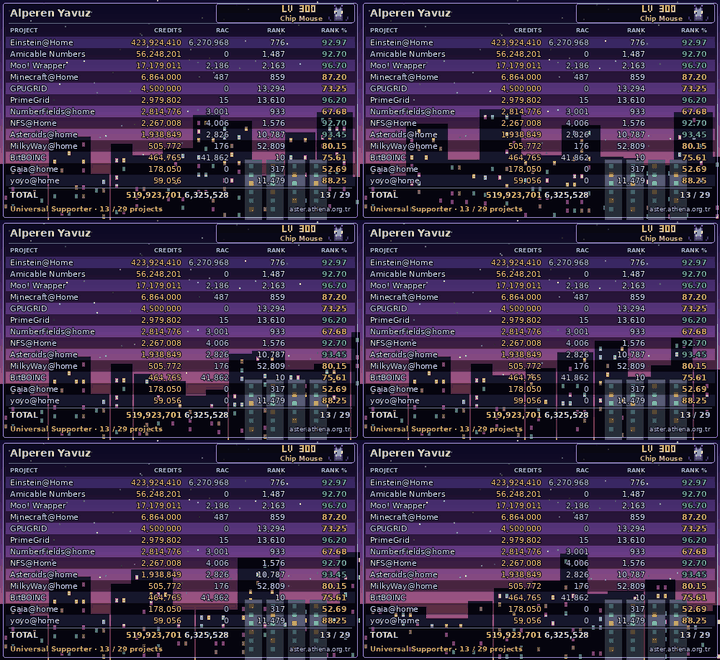
|


