
BitBOINC
Thread 'KERAUNOS'
Message boards : Puzzles and science : KERAUNOS
Message board moderation
| Author | Message |
|---|---|
|
New member Send message Joined: 27 Sep 26 Posts: 41 Credit: 464,765 RAC: 41,862     
|
⚡ Keraunos -- what it is and how it works ⚡ Keraunos (Greek: "thunderbolt" -- sudden, striking, leaps across the sky) is BitBOINC's kangaroo-based discrete-log search 🦘. It's the app that actually has a realistic shot at finding a key in practical time -- but it can only be pointed at a puzzle whose public key is already visible on the blockchain. 🚀 Why it's so much faster than brute force Brute-forcing a private key in a range of width W takes, on average, W/2 tries. Keraunos instead runs Pollard's kangaroo method (the van Oorschot/Wiener parallel version): expected effort is only about 2*sqrt(2)*sqrt(W) group operations -- the SQUARE ROOT of the range width, not the range width itself. For a 70-bit-wide range that's the difference between "some multiple of the age of the universe" ⏳ and "genuinely reachable with enough combined compute" 💪. This efficiency is exactly why it NEEDS the public key exposed: the algorithm's math only works starting from a known point on the curve, not just an address hash. 🦘 How the search actually works 🐾 Every host releases "kangaroos" (tame and wild herds) that take pseudorandom jumps across the range. 🌟 Whenever a kangaroo lands on a "distinguished point" (a point meeting a rarity condition, e.g. specific low bits all zero), that point plus how far it's travelled gets written into a table shared by EVERY host working that puzzle, across every platform. 💥 When a tame kangaroo and a wild kangaroo land on the exact SAME distinguished point, comparing their recorded distances hands you the private key directly. 🔑 Because the jumps are randomized, hosts never need to coordinate or split up the range explicitly -- everyone just jumps and reports distinguished points, and more total jumps (more hosts, more hardware) means a collision gets found faster, same idea as more people buying lottery tickets together 🎟️. Right now Keraunos is working puzzle #140. 🧭 🔧 Recent fixes worth knowing about ✅ A real checkpoint bug was fixed: resuming a task used to accidentally reset all progress back to zero because of how the checkpoint was fingerprinted. Checkpoints now resume correctly. ✅ Linux CPU builds are now statically linked, which fixed real tasks failing on volunteer machines with an older glibc than our build toolchain assumed. ⭐ Keraunos now gets scheduling priority over Potamos (roughly 3:1) on hosts that could run either -- since it's mathematically much more likely to actually find a key once a puzzle's pubkey is exposed, that's where we'd rather your hardware spend its time first. 🖥️ Platforms supported CPU: 🪟 Windows -- x86, x64, ARM64 🐧 Linux -- x86_64, i686, aarch64, armhf, ppc64le, riscv64 🍎 macOS -- Apple Silicon 😈 FreeBSD -- x86_64 🤖 Android -- aarch64 GPU-accelerated 🚀 (Windows/Linux/macOS): 🟩 NVIDIA -- CUDA, Kepler/Volta-class and Turing-or-newer (separately tuned) 🟥 AMD -- OpenCL 🟦 Intel -- OpenCL ⬛ Apple Silicon -- Metal (cross-checked step-for-step against the CUDA/OpenCL implementations on real hardware before release ✅) 🛠️ Coming soon: Moore Threads MUSA GPU support -- the port is in progress, not yet built/released. ARM+CUDA (Jetson-class devices) is on the roadmap but not started yet. 🐛 Found a bug? Reply below -- especially anything around checkpoint/resume, distinguished-point counts that look wrong, or crashes on a specific GPU vendor. Include your OS/GPU and, if you can, the task's stderr output. 🙏 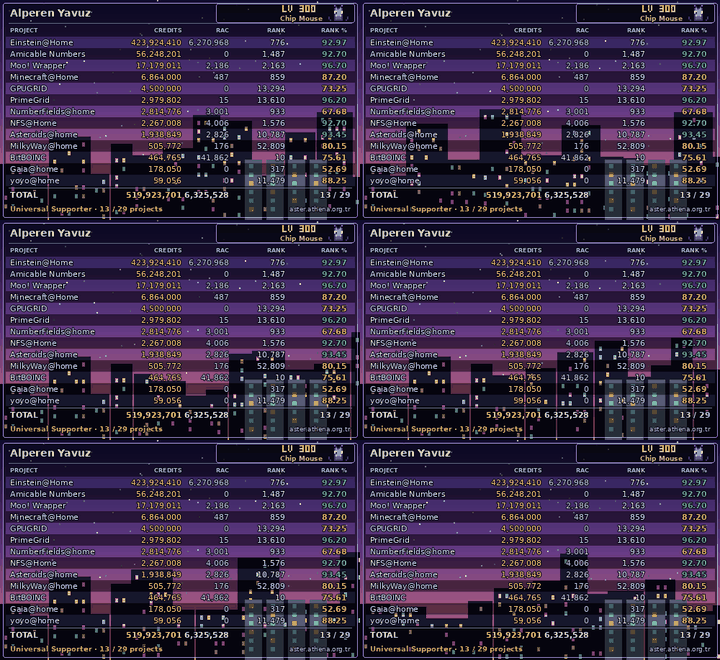
|


